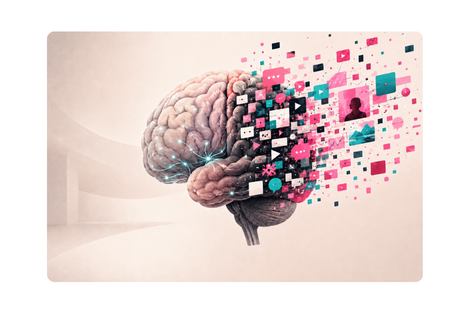
As artificial intelligence becomes more integrated into everyday life, are we adapting to it more than we realise?
Most people don’t notice behavioural change while it’s happening. It rarely arrives dramatically. It happens quietly, through repetition. A small shift in habit. A faster way of doing something. A task that suddenly feels easier than it did before.
Then, over time, what once felt unfamiliar starts feeling normal.
This is often how technology changes behaviour. Not by forcing transformation, but by gradually changing what people expect, tolerate and rely on. AI may be doing this faster than anything before it.
We already use it to summarise information, organise ideas, answer questions, and reduce the effort required for tasks that once demanded more concentration. In many cases, these tools feel incredibly helpful – almost invisible. But convenience changes behaviour. And the more seamlessly AI integrates into daily life, the more important the question becomes: what happens when thinking itself starts becoming easier to outsource?
The Brain Prefers Ease
The human brain is naturally drawn toward efficiency. Behavioural science has shown repeatedly that people conserve mental energy wherever possible. We create routines, rely on shortcuts and simplify decisions because cognitive effort is expensive.
There’s a useful way to picture this. The brain runs in two gears: a fast, automatic mode that reaches for the quickest answer, and a slower, effortful mode that does the heavy lifting of analysis and judgement – what psychologists describe as System 1 and System 2 thinking. The fast mode is the default. The slow mode costs energy, so the brain avoids it whenever it can.
AI fits perfectly into this pattern.
It removes friction. It speeds things up. It reduces the effort required to search, structure, write, interpret and respond. Tasks that once demanded sustained attention can now be completed in moments.
The brain responds positively to this reduction in effort. Faster answers feel rewarding. Less uncertainty feels calming. Over time, behaviours that reduce effort become automatic. This is not necessarily a problem. But it does begin to shape the relationship people have with thinking itself.
When Convenience Changes Engagement
There is a difference between using technology to support thinking and using it to replace engagement. Most people have already experienced small versions of this shift. Phone numbers disappeared from memory once smartphones began storing them. Navigation skills changed once GPS became constant. Search engines reduced the need to retain information because answers were always accessible.
That last shift even has a name. Researchers call it the Google Effect: when we know information is only a search away, we remember where to find it rather than the thing itself. Our memory quietly reorganised itself around the tool.
Generative AI expands this dynamic further because it does not simply store information. Powered by large language models, it increasingly interprets, structures, and responds on our behalf. And while this creates efficiency, it may also reduce the amount of mental effort people invest in the process itself.
Not because people are becoming less intelligent, but because the need to engage deeply starts decreasing.
The Science Has a Name for it: Cognitive Offloading
Cognitive offloading is defined as the act of handing mental work to an external tool so the brain doesn’t have to carry it. Writing a reminder, using a calculator, saving a number in your phone: all cognitive offloading. It’s one of the most natural things the brain does, and most of the time it serves us well.
AI changes the scale. Earlier tools mostly offloaded storage. Generative AI offloads the reasoning itself, including structuring, interpreting and deciding that thinking used to require. Research is now starting to measure what happens when that becomes a habit.
In a peer-reviewed study of 666 people across a range of ages and backgrounds, researcher Michael Gerlich found a significant negative relationship between frequent AI use and critical thinking, with cognitive offloading as the mechanism connecting the two. The heaviest users tended to score lower on critical thinking, and younger participants (the ones who have leaned on these tools longest) showed the strongest pattern. The point isn’t that AI makes people less capable. It’s that reaching for the easy answer, again and again, can weaken the inclination to do the harder thinking.
A widely discussed study from MIT’s Media Lab pushed the question further, using an EEG to observe what happened in the brain while people wrote with and without AI assistance. They proposed a concept called “cognitive debt”, the long-term cost of consistently letting a tool do the thinking. This is an early finding rather than a settled one (the paper is a preprint that has prompted healthy debate among researchers) and it should be read with that caution. But the direction it points is hard to ignore. A conversation that used to be philosophical is becoming, at least in part, observable.
None of this is an argument against AI. It’s an argument for paying attention to how we use it.
The Feeling of Understanding
One of the more interesting effects of AI is how quickly it creates the feeling of clarity. Information arrives structured, polished and simplified. Complex ideas become easier to consume and answers feel immediate and complete.
But there is an important difference between recognising information and truly understanding it.
That gap has a name too. Metacognition: your ability to monitor how well you actually understand something. AI is unusually good at disrupting it. When an answer arrives fluent and well-organised, the brain reads that smoothness as evidence that it has understood, when often it has only recognised. The feeling of understanding outpaces the real thing.
Understanding usually requires some level of effort. Reflection. Interpretation. Time spent sitting with uncertainty before clarity emerges. When answers arrive instantly, those moments become less common.
There’s a second force at work. Because chatbots communicate in confident, fluent, human-sounding language, we instinctively credit them with human qualities like competence, authority, and even honesty. Psychologists call this anthropomorphism, and it nudges us toward over-trust: the more human a system sounds, the less we tend to question it. The experience feels productive because the interaction is smooth. But smoothness can create the illusion of comprehension rather than comprehension itself. A confident, articulate answer can still carry the hidden biases of the data and algorithms behind it. Because AI communicates with increasing confidence and fluency, the brain often interprets that confidence as reliability.
Behaviour Adapts
Technology not only changes what people do. It changes what feels normal. Social media changed expectations around attention and stimulation. Smartphones changed the relationship people have with boredom, silence and availability. Streaming platforms changed patience. Search engines changed memory.
AI may now be changing the relationship people have with effort, thinking and decision-making. Already, many people feel frustrated when something takes too long to explain, when writing feels mentally demanding, or when answers are not immediate. The threshold for effort begins to shift once convenience becomes the standard.
Behavioural adaptation happens surprisingly quickly. The more often something removes friction, the more unusual friction begins to feel.
The Risk of Passive Thinking
The challenge is not AI itself. The challenge is the possibility of becoming passive in the presence of convenience. When answers appear instantly, people naturally spend less time wrestling with uncertainty, exploring alternatives, or forming conclusions independently. Over time, this can weaken the habit of active thinking. Not because the brain loses capability, but because engagement changes.
There is an important distinction between assistance and substitution.
When AI supports thinking, it can expand creativity, reduce repetitive work and create more space for strategic or meaningful tasks. But when it replaces the thinking process entirely, something else begins to shift.
The interaction becomes less participatory and over time, reduced participation can influence confidence in independent judgment.
Adaptation Works Both Ways
Much of the conversation around AI focuses on how systems are learning to adapt to humans. But adaptation is happening in both directions.
Humans are adapting too.
This is the two-way street of human–computer interaction: the system learns from us, and we quietly reshape ourselves around it. Attention patterns are changing. Expectations around speed are changing. Even creativity is evolving as people begin collaborating with systems that can generate ideas, visuals, and responses instantly.
This does not mean human capability disappears. Human behaviour has always adapted to new environments and technologies. The more important question is whether these changes remain intentional, because behavioural shifts are easiest to notice in hindsight.
Efficiency vs Depth
There is a growing tension between efficiency and depth. Efficiency saves time. Depth requires engagement.
AI is remarkably effective at reducing the effort involved in many cognitive tasks. But some forms of mental effort are not obstacles to remove. They are part of what creates learning, creativity, judgment, and insight in the first place.
The discomfort of thinking through complexity is often where understanding develops. If every difficult moment is bypassed immediately, something valuable may quietly disappear alongside the friction.
What This Means Moving Forward
AI will continue to evolve, and human behaviour will continue to evolve with it. The question is no longer whether adaptation is happening. It already is.
The most useful stance is a deliberate one; neither rejecting these tools nor surrendering to them. The strongest approach treats AI as scaffolding: support that helps you reach a thought you couldn’t have reached alone, then steps back, rather than a substitute that removes the thinking altogether. Assistance builds capability. Substitution can erode it.
For businesses, this is a leadership and design question, not just a personal one. The organisations that benefit most from AI will be the ones that are deliberate about it. Clear on where it should accelerate the work and where human judgement has to stay in the loop, transparent about how it’s used, and accountable for the decisions it shapes. As AI governance and regulation continue to mature, that kind of intentionality won’t only protect the quality of thinking and the wellbeing of a team. It will protect trust with the people they serve.
The more important question may be what kind of thinkers we become in the process. Are we using AI to support human thinking, or slowly becoming less willing to engage deeply because the effort no longer feels necessary?
Because the most significant impact of AI may not be the technology itself, it may be the subtle behavioural changes that happen around it over time.
Technology will keep getting smarter. The advantage will belong to the people (and the businesses) who stay deliberate about how they think.